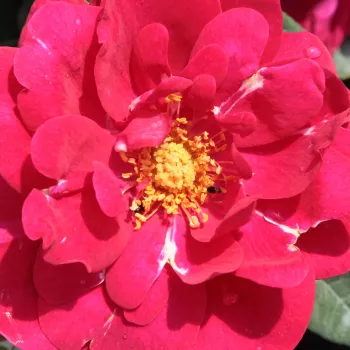
DIABLOTIN – red bedding floribunda rose – Delbard & Chabert
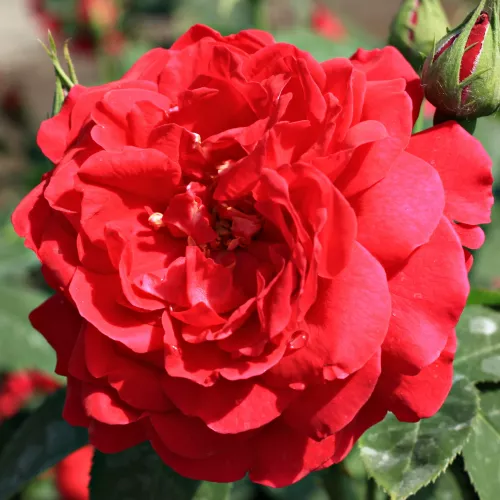
Bring a touch of Parisian charm to a small London front garden with DIABLOTIN, a compact floribunda that keeps its fiery red colour clean and vivid through weeks of changeable weather and brisk coastal winds. This bushy, matt-leaved shrub sits comfortably in narrow beds or large patio containers, forming a low, even hedge effect that works beautifully beside recycled-gravel paths and rainwater-fed planters, even where naturally heavy clay simply needs modest drainage improvement to thrive. Clusters of medium, cup-shaped blooms repeat reliably all summer, maintaining a tidy, well-arranged composition with only light deadheading. As an own-root rose, it offers reassuring longevity and the ability to regenerate from its base after stress, so you can enjoy stable performance as it moves from settling roots in the first year to stronger top growth in the second and full ornamental value by the third.
Usage options
| Target area |
Reasoning |
| Front garden bedding strip |
The compact, bushy habit and modest 60–90 cm height make DIABLOTIN ideal for narrow, street-facing beds where you want structure without blocking light. Regular clusters of red flowers create a strong welcome with little shaping, appealing to busy urban homeowners |
| Low informal hedge |
Planted at 35 cm spacings, the dense foliage knits into a low, continuous line that defines paths or separates drive and garden without feeling stark. The consistent height and spread simplify upkeep for family gardeners |
| Peat-free large container (40–50 L+) |
Its rounded growth and moderate root system adapt well to a large pot, especially in a rainwater-fed, peat-free mix. Continuous blooming and good disease resistance keep balcony or patio schemes looking deliberate for beginners with limited space |
| Small floribunda mass planting |
At 40 cm spacing and 6–7 plants per m², you gain a carpet of fiery red blooms that read as one bold block of colour. This works especially well in simple, low-maintenance schemes favoured by time-poor hobby gardeners |
| Urban rainwater-friendly planting |
Continuous flowering, dense foliage and moderate drought tolerance let DIABLOTIN sit happily with gravel mulches, permeable paving and rain chains, supporting gardens that handle frequent wet spells yet dry quickly, reassuring sustainability-minded city residents |
| Low-maintenance mixed border |
Good resistance to black spot, mildew and rust keeps foliage presentable in humid, enclosed gardens with minimal spraying or fuss. A simple prune and occasional deadheading maintain shape, which particularly suits low-input gardeners |
| Colour-stable focal point |
The fiery red flowers hold their brightness from bud to full bloom with only a slight matt softening, so the planting plan stays true to your chosen palette. This reliability helps design-conscious owners and style-focused beginners |
| Long-lived own-root planting |
Grown on its own roots, DIABLOTIN avoids the suckering and graft-failure issues of budded roses, regenerating from the base after hard pruning or winter damage, which offers long-term reassurance for practical home gardeners |
Styling ideas
- Urban-edge – Line a short front path with DIABLOTIN and low euonymus, underplanted with gravel to soak up rainwater – ideal for car-free, city-front gardens
- Balcony-border – Use a single rose in a 50 L terracotta pot with trailing thyme to soften edges – perfect for renters wanting portable colour
- Ruby-ribbon – Create a low hedge along a terrace using repeated plants interwoven with lavender – suited to homeowners seeking a simple, smart boundary
- Clay-friendly – Combine DIABLOTIN with nepeta and hardy sage in a slightly raised bed over improved clay – good for those coping with heavy London soils
- Modern-parterre – Plant in geometric blocks with clipped box alternatives and pale gravel to echo formal gardens in a compact space – appealing to design-led small-garden owners
Technical cultivar profile
| Aspect |
Data |
| Name and registration |
Floribunda bed rose; registered as DELpo, traded as Diablotin bedding rose DELpo; ARS exhibition name Diablotin; shrub rose type within bedding collection, suitable for repeated garden use. |
| Origin and breeding |
Bred by Georges Delbard and André Chabert in France from ‘Orléans Rose’ × ‘Fashion’; introduced and registered in 1961 by Roseraies Georges Delbard for robust bedding performance. |
| Awards and recognition |
Trial Ground Certificate, National Rose Society UK (1961); certificates at Madrid and Bagatelle international rose trials; silver medal from Société Nationale d’Horticulture de France, confirming proven garden merit. |
| Growth and structural characteristics |
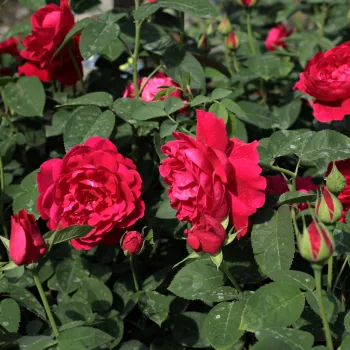
Compact, bushy shrub 60–90 cm high and 50–70 cm wide, with dense, matt, mid-green foliage and moderate prickles; forms a neat, rounded outline well suited to edging, low hedging and structured planting schemes. |
| Flower morphology |
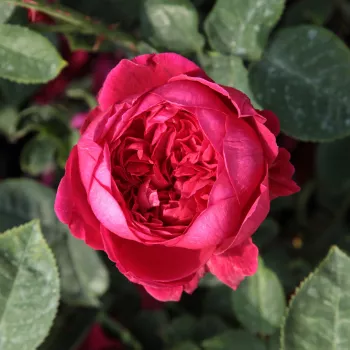
Medium, cup-shaped, double flowers with 26–39 petals appear in clusters; remontant habit ensures a generous second flush and continued clusters over the season, maintaining strong visual impact in beds and pots. |
| Colour data and phenology |
Fiery red petals, RHS 46A outer and 46B inner surfaces; colour remains vivid from bud to full bloom, only gently mattifying as flowers age, so overall effect stays bright, even in summer sun and variable weather. |
| Fragrance and aroma |
Classed as an unscented rose with no noticeable fragrance; chosen primarily for reliable colour effect, bedding performance and floral mass rather than scent-focused plantings or cutting for perfumed indoor use. |
| Hip characteristics |
Occasional small spherical hips, 6–9 mm across, in orange-red tones; usually incidental within normal maintenance regimes, as deadheading for continuous flowers tends to reduce hip formation in most garden situations. |
| Resistance and winter hardiness |
Resistant to powdery mildew, black spot and rust; hardy to approximately –21 to –18 °C (RHS H7, USDA 6b, Swedish zone 3), with continuous flowering in heat given supplementary watering during prolonged droughts. |
| Horticultural recommendations |
Suitable for beds, edging, containers, low hedges and urban greenspace; plant 35–65 cm apart in sun or partial shade; prefers well-drained soil and benefits from regular deadheading and spring pruning to renew flowering wood. |
DIABLOTIN offers compact structure, vivid long-lasting red flowers and dependable disease resistance in an own-root form that promises steady, low-fuss performance; a considered choice if you favour resilient, colour-rich planting.