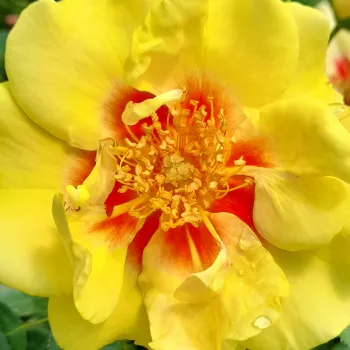
Eye of the Tiger – yellow bedding floribunda rose – Warner
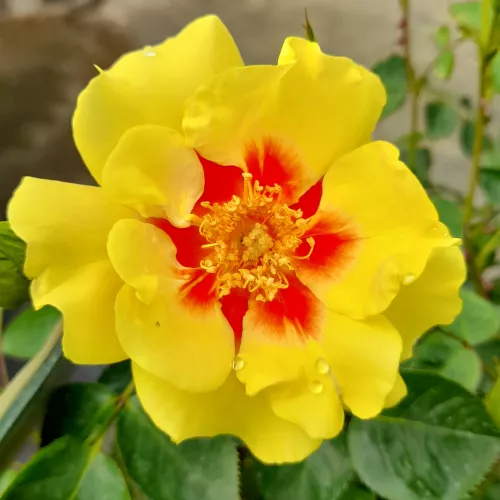
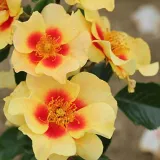
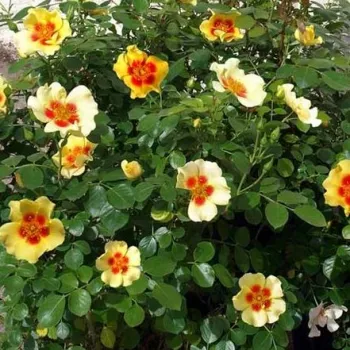
Planted in a small London front garden or on a urban balcony, Eye of the Tiger quickly settles into a steady rhythm of colour, sending up clusters of sunshine-yellow blooms brushed with a vivid red eye that pollinators adore and that cope reliably with blustery, damp spells and heavier soils often found in British family plots. This compact floribunda is bred for generous, season-long flowering, yet remains straightforward to manage, with medium maintenance needs and naturally tidy, bushy growth that suits narrow beds and edging. Its single, open flowers are especially pollinator-friendly, turning each flush into a small wildlife event while you enjoy their soft, discreet fragrance from a doorstep chair. Strong own-root structure supports longevity and helps the plant regenerate if ever cut back hard, building a durable presence in sustainable, low-fuss planting schemes. In a generous 40–50 litre container or open ground, this rose offers reassuring reliability through Year 1 roots, Year 2 shoots, Year 3 full ornamental value development, with dense, glossy foliage adding a healthy backdrop to its striking bicolour display. Over time, its moderate self-cleaning keeps beds looking orderly, and the rose’s proven trial awards give extra confidence that it will hold its own in real-world British conditions.
Usage options
| Target area |
Reasoning |
| Small front garden bed |
Compact, bushy growth and medium height make Eye of the Tiger ideal along a terraced-house front path, where its season-long flowering gives repeated bursts of colour with minimal shaping or staking for busy urban gardeners |
| Pollinator strip by doorstep |
The single, open blooms with easily reached stamens are highly attractive to bees and hoverflies, creating a lively, wildlife-friendly feature right by the front door without sacrificing neatness for nature-conscious beginners |
| 40–50 litre container on balcony or patio |
Its well-branched, bushy habit and moderate root system adapt well to a large pot, where own-root resilience and regular top flowering deliver a long-lived, movable accent for space-limited city dwellers |
| Low hedge along path or drive |
Recommended planting distances allow you to form a low, flowering hedge whose dense, glossy foliage knits together, guiding visitors with reliable structure and colour for family-home owners |
| Mixed bed with perennials |
Continuous flowering and a strong bicolour eye provide a vivid backdrop to softer perennials, while moderate maintenance needs keep the whole border manageable for time-poor hobby gardeners |
| Rainwater-conscious front garden |
Own-root durability and moderate care needs make it a good choice where downpipes feed beds and heavier soils may stay damp, so the plant copes steadily with frequent wet and blustery spells for sustainability-focused households |
| Neat edging for family play lawn |
A predictable, rounded shape with moderate self-cleaning helps hold a tidy line beside lawn or play space, reducing deadheading demands while still giving bright colour for parents with limited gardening time |
| Feature plant in small urban scheme |
Its recognised trial awards and stable, repeating display offer confidence that one well-placed shrub can anchor a compact scheme and look composed for many seasons, reassuring first-time rose buyers |
Styling ideas
- Doorstep Welcome – Plant Eye of the Tiger in a 50 litre container by the front door, underplanted with trailing thyme for scent and soft edges – for urban homeowners wanting instant kerb appeal.
- Pollinator Ribbon – Run a low strip of Eye of the Tiger along the pavement edge, interspersed with catmint and sage to extend nectar and colour – for wildlife-friendly city gardeners.
- Sunrise Border – Combine its yellow-and-red blooms with lavender and blue nepeta to frame a small lawn, giving balanced, easy-care colour – for families seeking relaxed structure.
- Graphic Contrast – Set the bright flowers against Euonymus fortunei ‘Minimus’ and low grasses to highlight its strong eye pattern – for design-led owners of compact front gardens.
- Container Quartet – Group four large tubs with Eye of the Tiger, calamint and baby’s-breath to create a portable mini-hedge on balconies – for renters wanting flexible, movable planting.
Technical cultivar profile
| Property |
Data |
| Name and registration |
Floribunda, Hybrid Hulthemia persica bedding rose; registered as CHEwbullseye, marketed as Eye of the Tiger bedding floribunda rose, exhibition category exhibition bush rose (floribunda). |
| Origin and breeding |
Bred by Christopher Hugh Warner (Chris Warner Roses, Shropshire, UK) from ‘Belting Pink’ × ‘Golden Age’; bred 2006, registered 2011, introduced 2015 via Pépinières de la Saulaie. |
| Awards and recognition |
RNRS Certificate of Merit St Albans 2014; Gold Standard – Gold Standard Rose Trials 2015; First Prize Lyon Rose Competition 2015; Novelty Award New Zealand National Rose Competition 2016. |
| Growth and structural characteristics |
Bushy shrub habit, 85–115 cm high and wide, with dense, mid‑green glossy foliage and moderate prickles; forms a rounded, full presence suitable for bedding, edging and low hedges. |
| Flower morphology |
Single to semi-single clusters, 5–12 petals, flat medium-sized blooms 1.5–2.75 in across; remontant with plentiful repeat, borne in clusters that give strong bedding and display value. |
| Colour data and phenology |
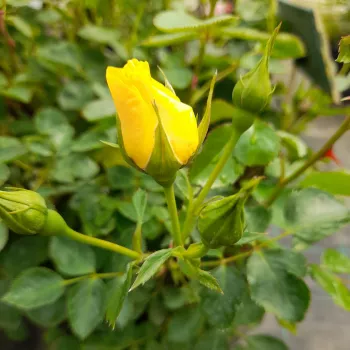
Sunshine yellow petals (RHS 14A) with deep carmine-red eye (RHS 53A); buds open bright, then fade to buttery yellow with softer rose-red eye as blooms age, retaining a striking central spot. |
| Fragrance and aroma |
Soft, discreet fragrance of mild strength; enough to notice at close range on still days without overwhelming nearby seating areas or scent-led planting combinations in small gardens. |
| Hip characteristics |
Occasional small, globose hips 6–9 mm in diameter, orange-red when ripe; ornamental interest is modest and does not significantly alter the plant’s overall neat appearance. |
| Resistance and winter hardiness |
Hardy to about −34 to −32 °C (RHS H7, USDA 4a, Swedish zone 5); moderate disease resistance to powdery mildew, black spot and rust with routine monitoring and timely care. |
| Horticultural recommendations |
Prefers sunny sites; medium maintenance with occasional pest and disease control; suitable for beds, edging, containers (≥40–50 L), low hedges and urban green spaces at recommended spacings. |
Eye of the Tiger offers long-season colour, pollinator-friendly single blooms and a tidy, bushy shape, all on a durable own-root plant that rewards patient gardeners looking to invest in a reliable, characterful rose.