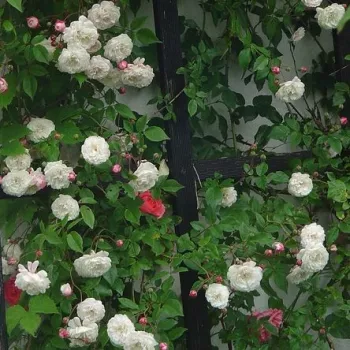
FÉLICITÉ ET PERPÉTUE – white historic rambler rose (climbing/trailing) - Jacques
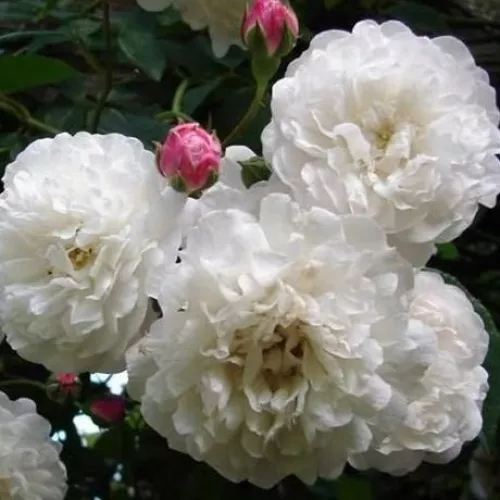
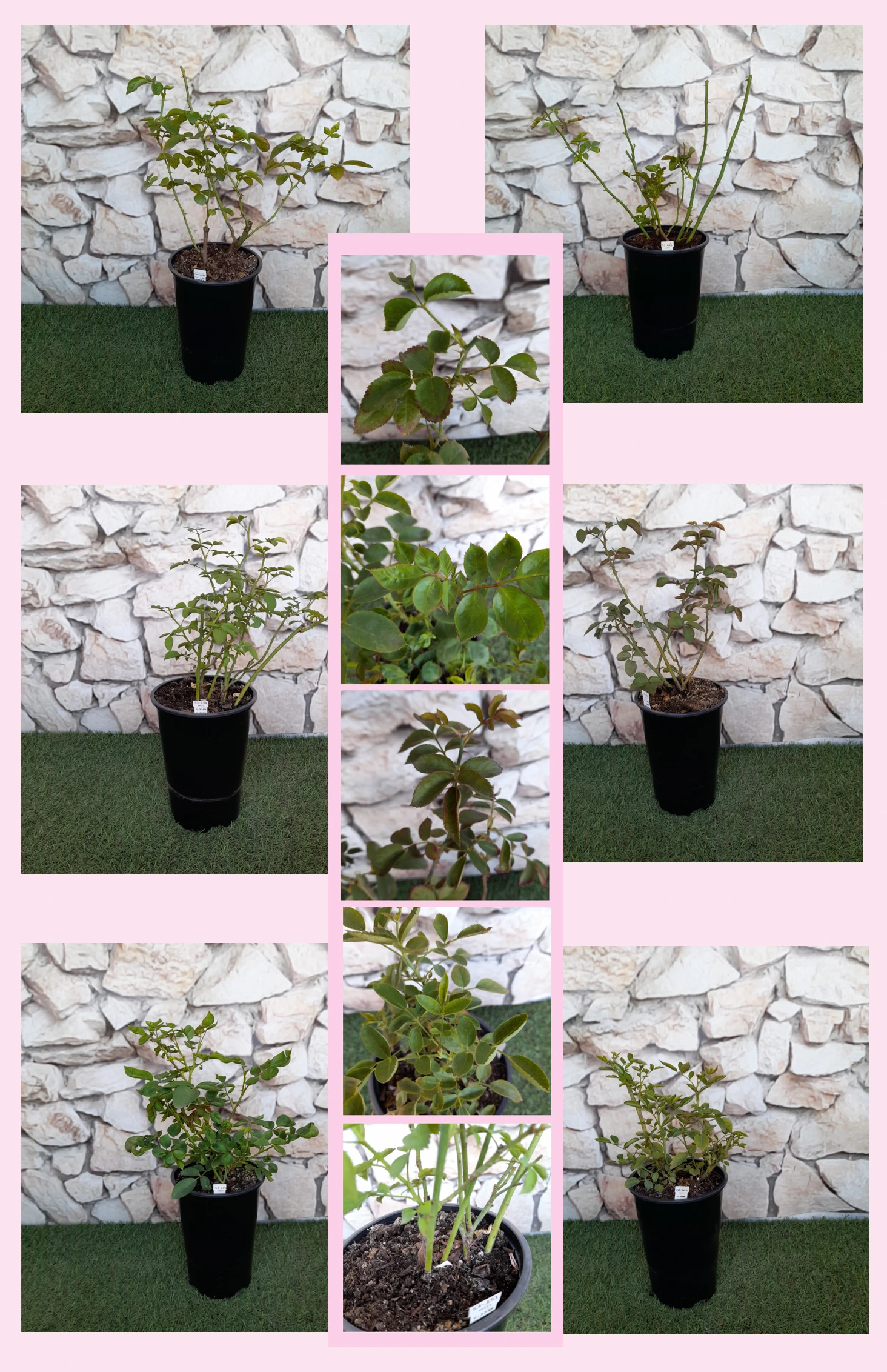
Choose heritage elegance for your London front garden with Félicité et Perpétue, a softly cascading rambler that turns walls, railings and arches into living curtains of bloom. Compact double pompon flowers open from blush buds to creamy white, holding their colour well even in summer sunlight. This historic 1820s rose is naturally healthy, with glossy mid-green foliage and strong resistance to common fungal diseases, so it copes gracefully with damp UK seasons and blustery, rain-lashed coastlines. Once established, its reliable hardiness and own-root stamina support a long-lived, low-intervention planting, ideal where you wish to reduce chemical sprays. In a typical family garden you simply guide its canes along trellis or pergola, then enjoy its once-a-year abundance, knowing it will slowly strengthen from roots in year one, structure in year two and full ornamental presence by year three.
Usage options
| Target area | Reasoning |
|---|
| Terraced-house front wall or railings |
Ideal where space is tight but you want big impact: trained along railings or a narrow wall, this rambler forms a romantic sheet of small, double pompon blooms while staying flat against the surface, leaving room for bins, bikes and children’s access, perfectly suiting the busy urban homeowner audience. |
| Rainwater-conscious town garden pergola |
Its deep-rooting own-root system and good heat and drought tolerance let it draw on stored soil moisture, making it well suited to gardens relying on collected rainwater rather than frequent mains watering, especially in heavier UK clay that drains slowly after storms, for environmentally minded city gardeners audience. |
| Low-chemical family garden feature |
Strong natural resistance to black spot, powdery mildew and rust means fewer sprays, less time spent on problem-solving and more time simply enjoying the display, an advantage if children and pets share the garden and you prefer a low-input approach as a health-conscious household audience. |
| Shady side return or part-shaded passage |
This rambler accepts partial shade, so it can brighten side alleys or north-east aspects where many roses sulk, clothing fences or wires in dense, glossy foliage and clusters of white bloom that visually widen narrow passages for space-stretched terraced-home owners audience. |
| High trellis or arch for vertical screening |
With its ability to reach well over five metres, it easily wraps around tall trellis, arches or arbour structures, creating a soft green veil that screens neighbouring windows or overlooked seating areas while needing only light seasonal tying-in for privacy-seeking gardeners audience. |
| Climbing into a mature tree |
Lightly thorned, supple growth makes it comparatively straightforward to thread through the lower branches of an existing tree, allowing romantic white cascades to appear among foliage in early summer without the bulk of a standard climber, appealing to informal woodland-style garden lovers audience. |
| Long-term heritage collection or period garden |
As an 1827 hybrid Sempervirens with a prestigious Royal Horticultural Society Award of Garden Merit, it carries authentic historical character backed by proven garden performance, making it a reliable choice for traditional schemes and lovers of documented old roses audience. |
| Low-maintenance boundary or backdrop planting |
Once its framework is established, this non-remontant rambler mainly needs an occasional post-flowering tidy and basic training, rewarding minimal effort with a generous early-summer flush and attractive foliage that quietly frames herbaceous borders for time-poor hobby gardeners audience. |
Styling ideas
- Romantic-Frontage – Train over a simple black metal railing with lavender or Nepeta at ground level, softening a narrow pavement edge and giving a gentle, feminine welcome – ideal for style-conscious urban terrace owners.
- Green-Curtain – Let canes drape along taut horizontal wires across a brick wall, underplanted with dwarf Heuchera and soft grasses to create a cooling, sustainable façade – suited to low-maintenance city gardeners.
- Period-Pergola – Combine this historic rambler with sage and pale pink lupins by a seating pergola, echoing traditional cottage gardens while staying manageable – perfect for fans of classic English planting.
- Tree-Garland – Allow stems to climb into a small ornamental tree, leaving the trunk clear and adding a white midsummer halo above a simple mulch circle – appealing to gardeners seeking a woodland edge feel.
- Curtained-Hideaway – Use it to cloak an arbour at the end of a small lawn, with low mounded perennials in front, creating a semi-private nook for reading or children’s play – great for family-focused garden users.
Technical cultivar profile
| Parameter | Data |
|---|
| Name and registration |
Félicité et Perpétue is a historic Hybrid Sempervirens rambler, commercial type heritage climbing rose, sold under the trade name FÉLICITÉ ET PERPÉTUE – white historic rambler rose (climbing/trailing) - Jacques. |
| Origin and breeding |
Bred by Antoine Jacques in France at the Château de Neuilly gardens, from Rosa sempervirens crossed with a Noisette rose; introduced around 1827 as an unregistered but widely recognised historic garden cultivar. |
| Awards and recognition |
Holder of the Royal Horticultural Society Award of Garden Merit since 1993, and honoured as Dowager Queen by the American Rose Society in 2001, underlining long-term reliability and collector interest. |
| Growth and structural characteristics |
Strong climbing rambler reaching about 5–8 m high with a 3–5 m spread, carrying glossy mid-green foliage on relatively sparsely thorned canes, suitable for walls, arches, pergolas and training into trees. |
| Flower morphology |
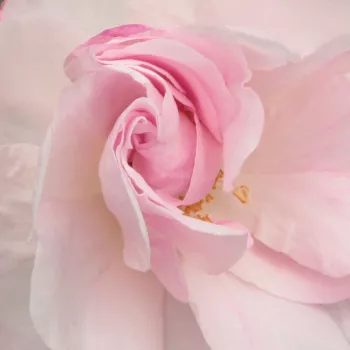
Small, very double, globular pompon blooms with over 40 petals, carried in generous clusters; flowers once in early summer rather than repeating, creating a concentrated, theatrical display at peak season. |
| Colour data and phenology |
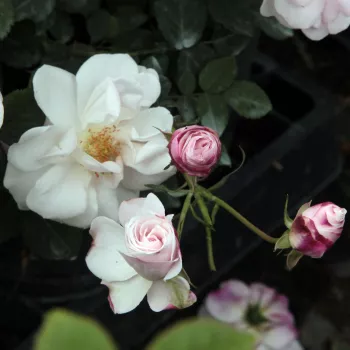
Buds open pale pink-cream, shifting to creamy white with a faint pink sheen before maturing to clean off-white; colour holds well without strong fading, giving a calm, uniform effect over the flowering period. |
| Fragrance and aroma |
Offers a classic rose fragrance of very weak intensity, more a gentle, background note than a dominant scent, allowing it to combine easily with strongly perfumed nearby plants without overwhelming the space. |
| Hip characteristics |
Occasionally sets small spherical orange-red hips, around 8–12 mm across, which can add modest seasonal interest in late summer to autumn, though plants are primarily grown for their dense flowering display. |
| Resistance and winter hardiness |
Good overall disease resistance, notably to black spot, powdery mildew and rust; winter hardy to approximately –21 to –18 °C (RHS H7, USDA 6b), performing reliably in a wide range of temperate UK conditions. |
| Horticultural recommendations |
Plant in well-prepared soil with decent drainage; allow space for its eventual height and width, and use a sturdy support. Best in open ground, with any large container use requiring a minimum of 40–50 litres volume. |
Félicité et Perpétue rewards you with heritage character, strong disease resistance and impressive height on a long-lived own-root framework, making it a thoughtful choice for a relaxed, low-intervention family garden.