GOLDSPATZ ® – light yellow park rose - Kordes & Kordes
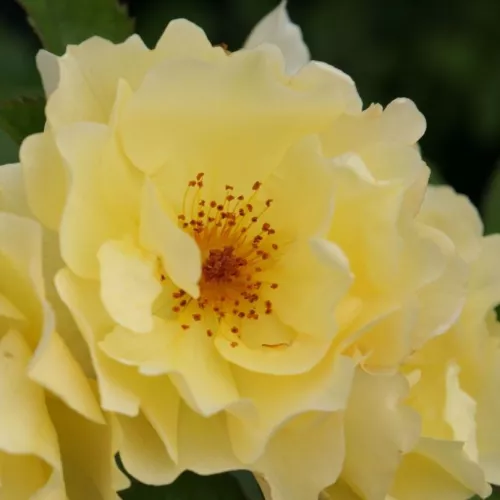
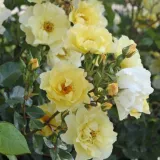
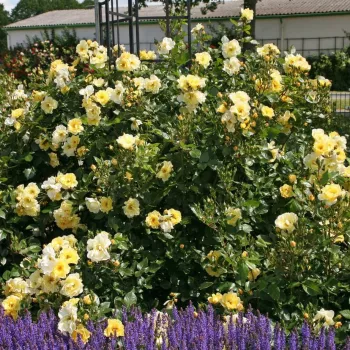
Step out after rain to find Goldspatz quietly brightening your front garden, its soft straw-yellow clusters echoing sunshine against dark green foliage, while its semi-double, open blooms invite bees with easy-to-reach stamens and pollen. Bred by Kordes for strong disease resistance and ADR reliability, this bushy shrub thrives even where damp weather and heavy soil meet, coping gracefully with blustery showers and challenging clay conditions when drainage is sensibly improved. As an own-root plant it offers reassuring longevity, rebuilding from its base if stems are damaged, so you enjoy stable, repeat flowering rather than worrying about graft failure. In a London terrace or compact urban front garden it settles in with remarkably low maintenance, needing only light annual pruning and modest feeding to keep its arching, hedge-forming shape. In year one it focuses on strong roots, year two brings bolder shoots and flowering, and by year three it reaches its full ornamental value as a soft yellow, wildlife-friendly hedge or feature shrub. Its semi-double, self-cleaning clusters give a naturally tidy appearance, while moderate hip formation adds autumn interest without overwhelming seed set, supporting a quietly sustainable, pollinator-aware city garden.
Usage options
| Target area | Reasoning |
|---|
| Low-maintenance front-garden hedge |
Dense, bushy growth with arching shoots and self-cleaning flowers makes a soft, informal hedge that stays tidy with minimal pruning and feeding, ideal where time is short yet structure is needed for busy homeowners. |
| Pollinator-friendly city border |
Semi-double, open blooms with visible stamens offer easy access to pollen, drawing bees even in small urban gardens or rainwater-managed strips along pavements, appealing strongly to eco-conscious beginners. |
| Reliable repeat-flowering feature shrub |
Remontant flowering brings a strong second flush after the first display, extending colour well into late summer so a single shrub continues to earn its place, suiting gardeners who want long-lasting visual impact. |
| Compact park-style planting in small gardens |
Its upright-to-arching, park-rose habit and 120–180 cm height give a structured, “public garden” look on a family scale, delivering presence without dominating, which suits design-led but space-limited urban households. |
| Beginner-friendly family garden rose |
Strong overall health, ADR certification and resistance to common fungal problems reduce spraying worries, so new gardeners can focus on watering and simple pruning rather than complex care routines as their confidence grows. |
| Sustainable, long-lived own-root planting |
As an own-root shrub it regenerates from the base after winter damage, avoiding issues with failing grafts and keeping the same variety throughout its life, reassuring those planning long-term, low-intervention gardens. |
| Partial-shade side passage or narrow bed |
Tolerant of partial shade and naturally bushy, it fills awkward, narrow spaces along paths or between houses, handling damp breezes and periods of wet weather similar to coastal rain and wind in exposed streets. |
| Large container on balcony or paved front |
In a 40–50 litre peat-free container with good drainage, it brings park-like flowering to paved or balcony spaces, pairing well with herbs and perennials, ideal for urban residents without open soil beds. |
Styling ideas
- Terrace-hedge – Line a narrow London front garden with a low run of GOLDSPATZ®, underplant with lavender for scent and pollinators – for city homeowners seeking soft privacy and easy care.
- Rain-border – Combine GOLDSPATZ® with nepeta and ornamental grasses beside a permeable driveway to slow and filter rainwater – for sustainability-minded gardeners improving drainage on heavy soils.
- Golden-focus – Use a single shrub near the front door with sage and white alliums to create a calm, balanced entrance – for design-conscious beginners wanting reliable structure.
- Family-habitat – Mix GOLDSPATZ® with brunnera and ferns in a lightly shaded corner to offer bees forage and children seasonal interest – for families building a wildlife-friendly play-space.
- Balcony-grove – Plant one shrub in a 50 litre tub with trailing thyme and dwarf grasses for a mini “park” on paving – for flat dwellers wanting long-lived greenery without complex upkeep.
Technical cultivar profile
| Parameter | Data |
|---|
| Name and registration |
Shrub rose group, park rose commercial type; registered as KORgellan and marketed as Goldspatz ® Heckenzauber®; ARS exhibition name Goldspatz® in the Heckenzauber® collection. |
| Origin and breeding |
Bred by Wilhelm-Alexander Kordes at W. Kordes’ Söhne, Germany, with unknown parentage; registered in 2009 and introduced to the market from 2011 in Europe and North America. |
| Awards and recognition |
Holds ADR certification for garden performance; awarded a Silver Medal at the Paris-Bagatelle rose trials in 2009 and Trial Ground Certificate at St Albans (UK) in 2010. |
| Growth and structural characteristics |
Bushy shrub 120–180 cm tall and 60–110 cm wide; initially upright, later arching shoots; dense, glossy dark green foliage; densely thorned stems; good self-cleaning of spent blooms. |
| Flower morphology |
Semi-double, cup-shaped clusters with 13–25 petals; large blooms around 7–10 cm; cluster-flowering habit; remontant, with a pronounced second flush following the main early-summer display. |
| Colour data and phenology |
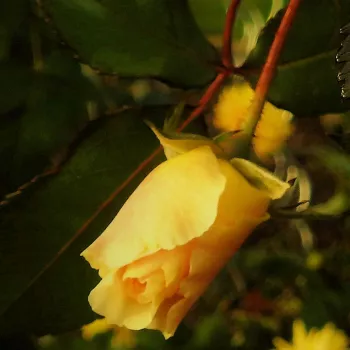
Light straw- to lemon-yellow flowers (RHS 8C outer, 11D inner) that gently fade to pale cream-yellow; colour holds best in moderate sun, softening in strong light and as blooms age. |
| Fragrance and aroma |
Sweet but extremely light scent, often perceived as almost unscented in the garden; chosen more for visual impact, health and flowering habit than for strong fragrance in exposed sites. |
| Hip characteristics |
Produces moderate quantities of small, spherical orange-red hips 7–12 mm across; adds discrete autumn interest without excessive seeding, suitable for informal, wildlife-leaning plantings. |
| Resistance and winter hardiness |
Rated H7 and USDA zone 5b, hardy to about –26 °C; resistant to powdery mildew, black spot and rust; moderate heat tolerance, needing watering during prolonged dry periods. |
| Horticultural recommendations |
Best at 80–90 cm spacing in hedges or groups; tolerates partial shade and heavier soils with improved drainage; low maintenance, needing light pruning and standard feeding for reliable flowering. |
GOLDSPATZ ® offers easy, repeat flowering, strong health and long-lived own-root reliability, making it a thoughtful choice for relaxed, sustainable gardens where you prefer simple, lasting structure to intensive care.