LUCCY® – yellow dwarf-mini rose - Barni
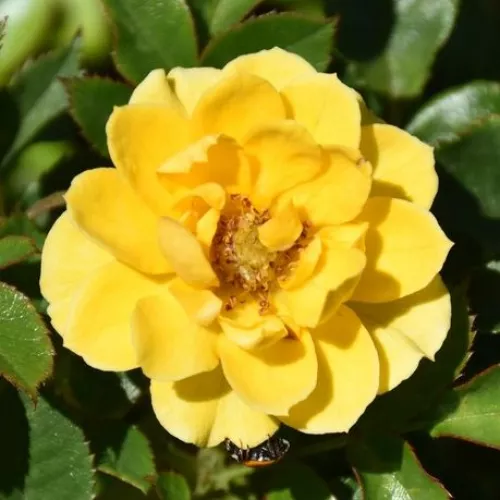
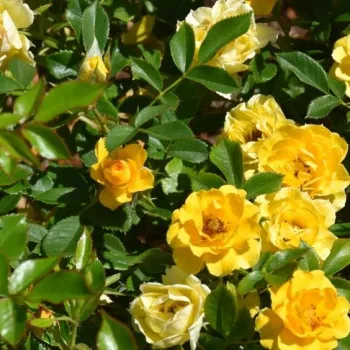
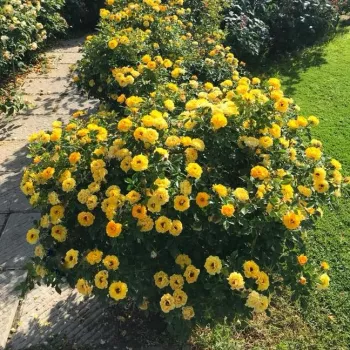
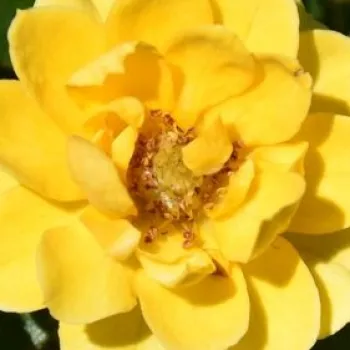
On a small London terrace or balcony, Luccy brings a ribbon of luminous, mid-yellow flowers that shine after rain and sit happily alongside well-drained beds that cope with wet spells and heavy showers, while its compact habit makes it easy to tuck into narrow borders or modest containers. Developed in Italy, this mini rose offers reliable flowering from early summer onwards, with abundant remontant flushes on dense, dark green foliage that keeps its shape without constant clipping. Its strong health means little spraying or intervention, and the own-root form gives long-term stability, quietly rebuilding itself if stems are damaged or pruned hard. In the first year it concentrates on roots, the second brings more leafy shoots, and by the third season you can expect its full ornamental value in your family garden.
Usage options
| Target area | Reasoning |
|---|
| Front garden edging for small city plots |
The compact, 30–40 cm height and spread create a neat low ribbon of yellow that defines paths and driveways without overwhelming a narrow front garden, offering season-long structure for the time-poor homeowner. |
| Balcony and terrace containers (40–50 litres+) |
Its dwarf habit and dense foliage suit larger pots where root volume is generous, giving reliable repeat bloom with simple watering and feeding, well suited to busy urbanites. |
| Low-maintenance family borders |
Good disease resistance and low maintenance needs reduce spraying and complicated care, making it straightforward to keep beds presentable around play areas and seating for the practical family. |
| Sunny rock or gravel gardens |
The miniature size fits between stones and drought-tolerant perennials; with regular watering in dry spells it will flower steadily, adding bright colour for the relaxed gardener. |
| Rainwater-aware front gardens with improved drainage |
Its modest root system pairs well with permeable surfaces and gravel mulches that handle sudden downpours and wet periods, supporting simple rainwater management for the sustainability-minded planner. |
| Colour-contrast planting with purple and blue perennials |
The clear mid-yellow blooms stand out against cool companions like lavender, sage or nepeta, giving a refined, contemporary palette that remains tidy for the style-conscious beginner. |
| Long-season accent in small mixed beds |
Remontant flowering gives repeated flushes, so a few plants provide colour from early summer well into the season, ideal when space is limited but impact still matters to the thoughtful owner. |
| Durable own-root planting for long-term schemes |
Grafted unions are absent, so plants age evenly, regenerate well after hard pruning or winter damage, and keep their shape over many years, appealing to the future-focused planner. |
Styling ideas
- Golden-edge path – line a short front path with LUCCY® at 35 cm spacings, underplanted with thyme for a soft, aromatic edge – ideal for small-house front-garden owners.
- Balcony spotlight – plant one LUCCY® in a 50-litre container with trailing nepeta and pea gravel mulch for drainage – perfect for busy balcony gardeners.
- Rock-garden spark – tuck LUCCY® among rocks with blue campanula and fine gravel to showcase its glowing yellow blooms – suited to urban rock-garden enthusiasts.
- Compact family border – mix LUCCY® with dwarf lavender and low grasses for a child-friendly, easy-care strip along the lawn – helpful for young families.
- Rainwise frontage – combine LUCCY® in a gravel strip with permeable paving and a rain butt, adding echinacea behind for summer height – attractive for sustainability-conscious homeowners.
Technical cultivar profile
| Parameter | Data |
|---|
| Name and registration |
Miniature rose from the Lillipuziane collection; registered as BARluccio, traded as Luccy® / Luccy® Lillipuziane, exhibition name Lucciola in miniature and potted categories. |
| Origin and breeding |
Bred by Enrico Barni, Rose Barni, Pistoia, Italy; introduced 2011 with Italian origins reflecting good sun tolerance; parentage undocumented but selected for compact habit and floriferous display. |
| Awards and recognition |
Miglior Rosa Miniatura 2011 at the International Rose Competition in Madrid and 2021 Certificate of Merit from the National Rose Trial Garden of Australia for miniature quality. |
| Growth and structural characteristics |
Compact, bushy, 30–40 cm high and wide, with dense, glossy dark green foliage and moderate prickliness; maintains a rounded form that suits edging, containers and small feature groupings. |
| Flower morphology |
Semi-double flowers, 13–25 petals, small (0.5–1.5 in), produced singly or in clusters of 1–3 per stem; flat form with medium self-cleaning, some deadheading recommended to tidy plants. |
| Colour data and phenology |
Clear bright mid-yellow blooms, ARS yellow, RHS 14A outer, 13B inner; colour holds well with minimal fading, providing intense lemon-yellow to golden tones from bud to full bloom. |
| Fragrance and aroma |
Fragrance is very weak and barely noticeable, making it suitable where strong scent is not desired; chosen primarily for its colour effect and compact growth rather than aromatic qualities. |
| Hip characteristics |
Rose hip production is generally low; may form occasional small spherical red hips 5–7 mm across, which add a discreet seasonal detail without seeding around aggressively. |
| Resistance and winter hardiness |
Good general disease resistance, with noted resistance to powdery mildew, black spot and rust; winter hardy to about −21 to −18 °C, corresponding to RHS H7 and USDA zone 6b performance. |
| Horticultural recommendations |
Best in sunny sites with reasonably drained soil; water regularly in dry spells, particularly in containers; ideal spacing 30–60 cm depending on use, with low maintenance requirements overall. |
LUCCY® offers compact yellow flowering, strong disease resistance and easy long-term performance on its own roots, making it a thoughtful choice for low-maintenance urban and family gardens.