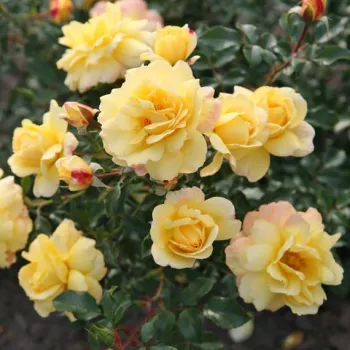
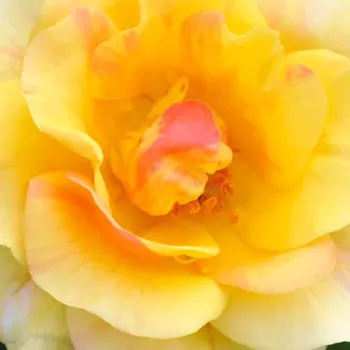
MELLITE – golden-yellow flowerbed shrub rose – Tanjga
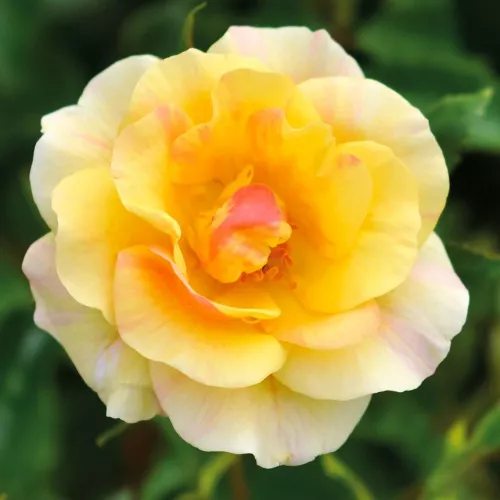
Step through your front gate and be welcomed by honeyed clusters of warm golden-yellow blooms: MELLITE brings a compact, balanced shrub form that fits effortlessly into small London front gardens and shared urban spaces. Its mid-green, slightly glossy foliage provides a calm backdrop to the changing tones of each flower, which open deep gold and soften to apricot and cream, echoing the subtle rhythm of the seasons. Planted in good soil with reliable drainage that copes well with persistent rain and wind in exposed gardens, this rose rewards regular care with a long repeat-flowering display and a clearly sweet fragrance that invites quiet contemplation. In a large 40–50 litre container or a narrow border, its uniform, proportional growth makes for neat structure along paths and railings, while the own-root form supports a long-lived, regenerating presence that settles into the garden scene year by year, becoming a gentle golden focus for your outdoor space.
Usage options
| Target area |
Reasoning |
| Narrow London front garden border |
The compact 40–60 cm height and spread allow you to edge a slim strip of soil without overwhelming paths or neighbouring properties, creating a tidy, golden frontage from late spring to autumn for the busy homeowner. |
| Rainwater-conscious entrance planting |
Planted into improved soil with good drainage near downpipes or along paving, MELLITE turns run-off into flower power, sitting securely despite frequent showers and brisk coastal-style winds for the sustainability-minded city-dweller. |
| Statement container on steps or balcony |
In a 40–50 litre pot with peat-free compost, its bushy, uniform habit forms a neat, upright dome that is easy to maintain and simple to water with collected rainwater, ideal for the space-limited balcony-gardener. |
| Small flowering hedge beside a path |
At 35–40 cm spacings, plants knit into a low, even hedge, giving a continuous ribbon of golden-yellow blooms that frame the walkway and soften hard boundaries, suiting the design-aware townhouse-owner. |
| “Girly” pastel-toned front garden scheme |
The warm honey-apricot fade works beautifully with soft pinks, creams and airy grasses, creating a romantic, feminine mood in even the smallest plot for the colour-loving style-seeker. |
| Formal bed with neat structure |
The proportional, compact growth helps maintain clean lines in geometric beds, so the planting looks organised rather than overgrown, even after strong flushes of flowers, pleasing the structure-focused planner. |
| Fragrant seating corner |
Placed close to a bench or doorway, its medium, clearly sweet fragrance is easy to appreciate at nose level, offering a modest sensory reward without overpowering spaces for the relaxation-hungry evening-sitter. |
| Mixed container with drought-tolerant companions |
Combined in a large pot with lavender or nepeta, MELLITE’s golden flowers rise from a cloud of grey-blue foliage, while the companions help buffer soil moisture, simplifying everyday care for the time-poor beginner. |
Styling ideas
- Golden-railings – Line a short black iron fence with MELLITE and low lavender for a chic, scented London frontage – ideal for style-conscious terrace owners.
- Honey-border – Mix MELLITE with dwarf heuchera and creeping thyme in a slim strip along the path – perfect for families wanting soft colour and easy access.
- Balcony-bouquet – Plant one MELLITE in a 50 litre pot with trailing thyme for overflow and a simple drip tray – suited to urban balcony gardeners using stored rainwater.
- Pastel-pocket – Combine MELLITE with pale pink roses and airy grasses in a tiny “girly” front bed – great for first-time gardeners seeking romantic impact.
- Orderly-edge – Use a short row of MELLITE to edge a driveway, backed by nepeta for soft contrast – for householders who like a structured yet welcoming entrance.
Technical cultivar profile
| Characteristic |
Data |
| Name and registration |
MELLITE (Mella®), registered as BOZangfre, a compact shrub/bed rose for flowerbeds and landscaping; sold as an own-root, container-grown plant under the eleanorROSE® ORIGINAL line. |
| Origin and breeding |
Bred by Biljana Božanić Tanjga for Pheno Geno Roses, introduced and registered in 2017 by PhenoGeno Roses (Serbia); parentage is not recorded or publicly disclosed. |
| Growth and structural characteristics |
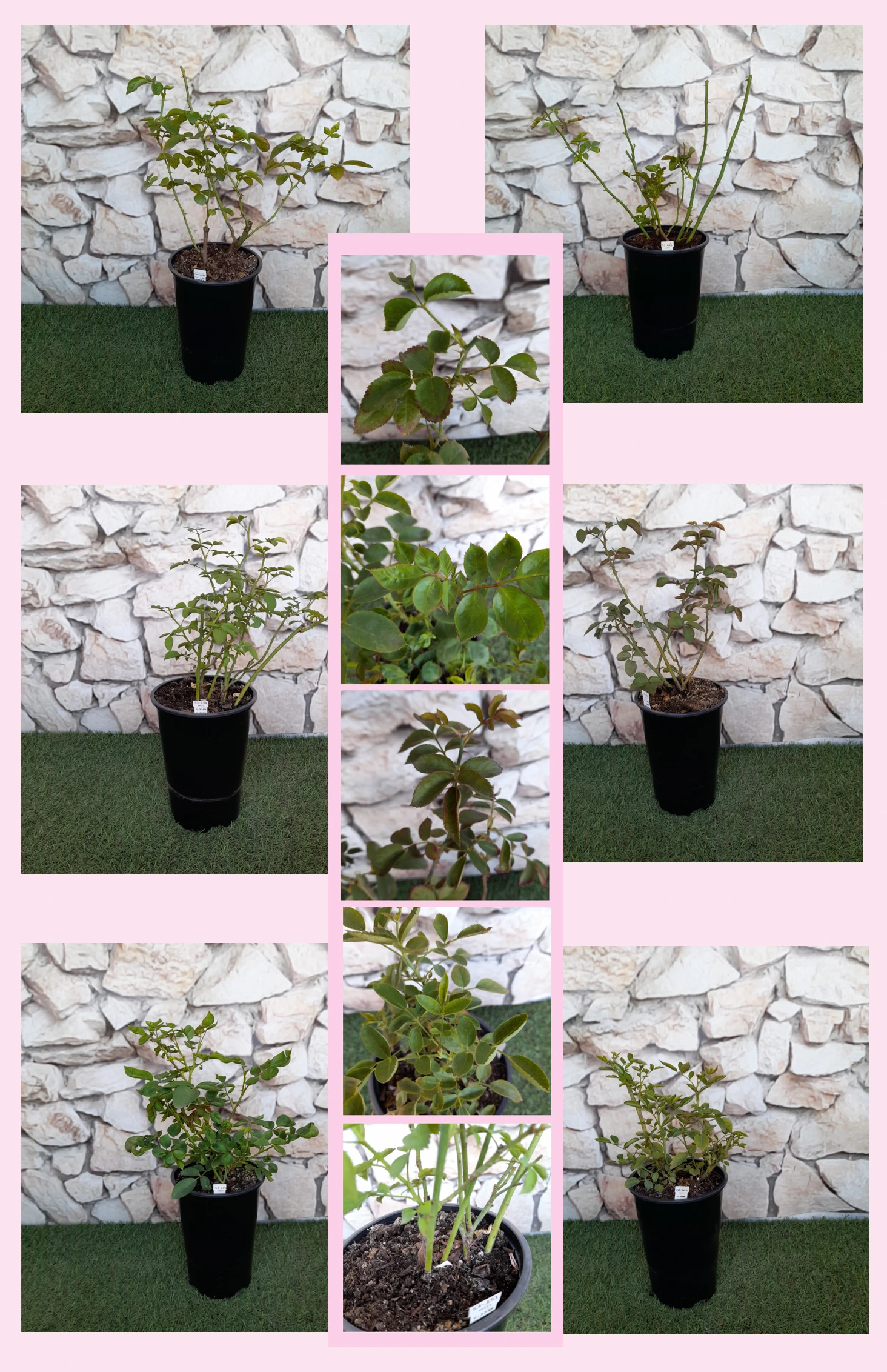
Compact, bushy shrub reaching about 40–60 cm in both height and spread, with dense, mid-green, slightly glossy foliage and moderate thorns, forming an even, proportional, low mound in beds or pots. |
| Flower morphology |
Medium-sized, double, cluster-flowered blooms with 26–39 petals; flat in shape, repeat-flowering with a notably abundant second flush that maintains decorative value through the main season. |
| Colour data and phenology |
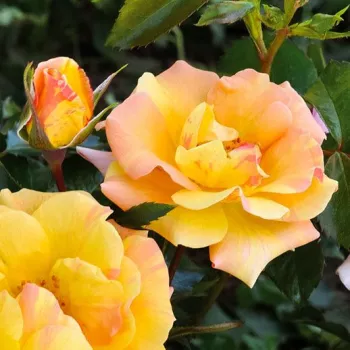
Deep warm golden-yellow buds with orange undertone open rich gold, then mellow through honey yellow to light apricot and creamy tones; colour retains well, giving a gentle, evolving display on each truss. |
| Fragrance and aroma |
Medium-strength, clearly perceptible sweet fragrance of classic rose character; best appreciated at close range, making it suitable near entrances, seating areas or container plantings on terraces. |
| Hip characteristics |
Fruit set is usually low due to double flowers, but small spherical orange-red hips 6–10 mm in diameter may form occasionally, adding modest autumn interest without significant self-seeding. |
| Resistance and winter hardiness |
Hardy to about −21 to −18 °C (RHS H7, roughly USDA 6b, Swedish Zon 3); disease resistance is weak, with high susceptibility to powdery mildew and black spot, requiring regular protective care. |
| Horticultural recommendations |
Best in fertile, well-drained soil or 40–50 litre containers; support health with good air flow, preventative spraying and careful watering, spacing plants 35–60 cm apart according to their design role. |
MELLITE offers compact golden-yellow flowering, a sweet fragrance and neat structure in beds or large containers, while its own-root form supports long-term regeneration and reliability, making it a thoughtful choice for enduring small gardens.