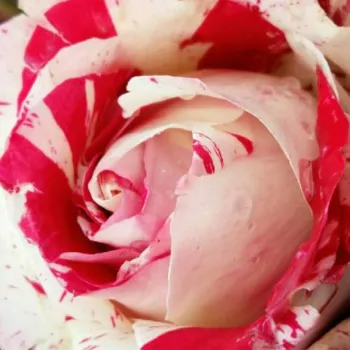
Rock & Roll™ – WEKgobnez red‑white bedding grandiflora rose
Bring a sense of rhythm and visual energy to a small London front garden with Rock & Roll™, a red‑and‑cream grandiflora whose large, striped blooms look especially striking beside paving, gravel or permeable driveways that help manage wet, heavy ground and frequent showers in exposed gardens. Its upright habit and dense, glossy foliage build a strong vertical presence in narrow beds, while own‑root cultivation supports long‑term balance and recovery if canes are ever cut back hard. You can enjoy strong, clearly scented flowers for cutting from midsummer onward, with a distinct second flush that keeps the display feeling lively well into autumn. Planted into deep, peat‑free soil and watered with collected rain, it settles steadily – roots in the first year, stronger shoots in the second, then full garden impact by year three for a sustainable investment in repeat flowering colour.
Usage options
| Target area | Reasoning |
|---|
| Front garden focal point |
The tall, upright habit and dense foliage give reliable structure in the small, visible beds typical of terraced houses, while the bold red‑and‑cream striping reads clearly from the pavement, appealing to urban homeowners |
| Statement container on steps or balcony |
In a 40–50 litre pot with good drainage, Rock & Roll™ forms a compact, vertical accent that flowers repeatedly for cutting, allowing colour and fragrance where borders are limited, ideal for busy balcony gardeners |
| Feature rose in mixed, rain‑aware planting |
The strong root system of this own‑root plant copes well when sited near permeable hard landscaping that channels excess water away from the house, complementing sustainable front‑garden layouts for eco‑conscious planners |
| Season‑long colour in a family flowerbed |
Its strongly remontant nature gives an abundant second flush after the first display, keeping borders bright through school holidays with little more than watering and the usual plant protection, reassuring for time‑pressed families |
| Cut‑flower corner for home arrangements |
Large, double, cup‑shaped blooms on sturdy stems provide dramatic striped roses that hold well in the vase, so a single plant can supply striking stems for the house across the season, attractive to creative home florists |
| Structured backdrop in a narrow border |
The 120–160 cm height and 75–110 cm spread create a leafy, upright screen that makes small gardens feel enclosed yet not overcrowded, giving a calm background for perennials and grasses valued by design‑minded beginners |
| Colour punch in partial‑shade spots |
Its suitability for partial shade means it can be placed where morning or late‑day sun reaches a side path or courtyard, bringing movement and warmth to corners that might otherwise remain dull for courtyard gardeners |
| Long‑term feature for settled gardens |
As an own‑root rose it can regenerate from the base if pruned hard or after winter damage, building a durable framework that rewards regular care over many years, suiting patient garden investors |
Styling ideas
- Doorway drama – Place Rock & Roll™ in a large frost‑proof container by the front door and underplant with low thyme for a scented, textural carpet – ideal for urban entranceways.
- Striped showcase – Combine it with white gaura and airy grasses in a slim front bed to let the bold red‑and‑cream flowers take centre stage – suited to design‑led town gardens.
- Evening cut‑flower corner – Plant alongside dusky salvias and nepeta to echo its stripes with cool tones and provide easy fillers for home bouquets – perfect for hobby flower arrangers.
- Rain‑smart frontage – Set behind permeable gravel or block paving with low sedums, allowing surface water to drain while the rose delivers vertical colour – appealing to sustainability‑minded households.
- Bold balcony duo – Grow one plant in a deep container with trailing ivy and compact lavender for contrast in form and fragrance – a good choice for compact balconies and roof terraces.
Technical cultivar profile
| Property | Data |
|---|
| Name and registration |
Grandiflora bed rose; registered as WEKgobnez, marketed as Rock & Roll™. American Rose Society approved exhibition name Rock & Roll™, suitable for bedding and grandiflora show classes. |
| Origin and breeding |
Bred by Tom Carruth (USA) from ‘George Burns’ × ‘New Zealand’, introduced by Weeks Roses in 2007. Developed as a striking, striped, strongly remontant grandiflora with exhibition potential. |
| Growth and structural characteristics |
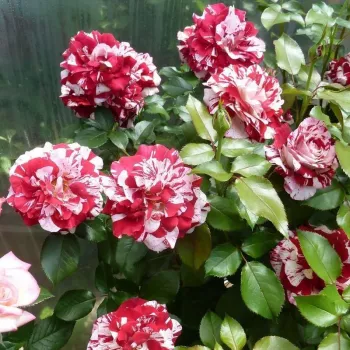
Upright plant, around 120–160 cm tall and 75–110 cm wide, with dense, glossy dark green foliage and moderate prickles. Forms a vertical, leafy framework suitable for feature or hedge planting. |
| Flower morphology |
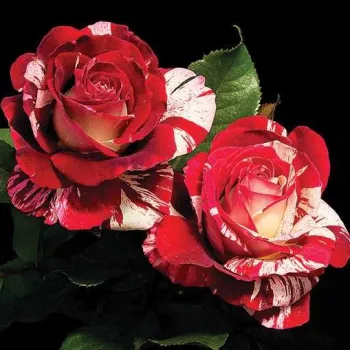
Large, double, cup‑shaped flowers with 26–39 petals, mainly borne singly. Strongly remontant, with a notable second flush, providing substantial display for bedding, cutting and specimen use. |
| Colour data and phenology |
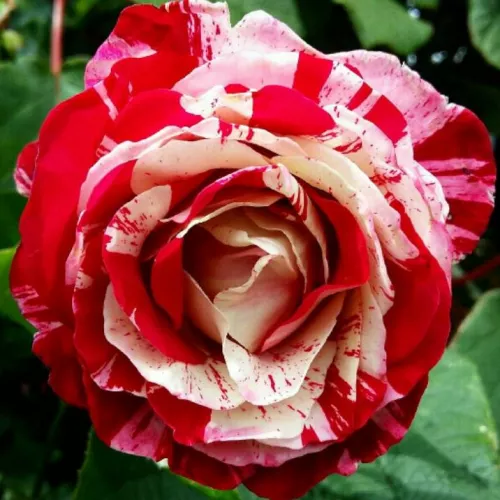
Vivid cherry‑red base speckled and streaked with cream‑white; contrast strongest in cooler weather. In heat the pattern softens to raspberry‑pink and creamy tones, giving a softer, blended effect. |
| Fragrance and aroma |
Clearly and strongly scented rose, with a pronounced perfume noticeable near paths and sitting areas. Fragrance character data are limited, but strength suits cutting for indoor enjoyment. |
| Hip characteristics |
Occasional spherical red hips 12–18 mm across, forming when spent blooms are left uncut. Mainly ornamental, adding subtle late‑season interest without dominating the plant’s appearance. |
| Resistance and winter hardiness |
Hardy approximately to −21 to −18 °C (RHS H7, USDA 6b). Disease resistance is moderate to low, particularly to rust, so regular monitoring and appropriate plant protection are recommended. |
| Horticultural recommendations |
Best in fertile, well‑drained soil with regular watering; avoid prolonged drought and extreme heat. Maintenance needs are higher than average, requiring routine plant protection and attentive care. |
Rock & Roll™ offers dramatic striped blooms, strong fragrance and a tall, structured presence, while its own‑root form supports long‑term regeneration and reliability, making it a thoughtful choice for your garden plans.