VIOLACEA – deep violet historic Gallica rose
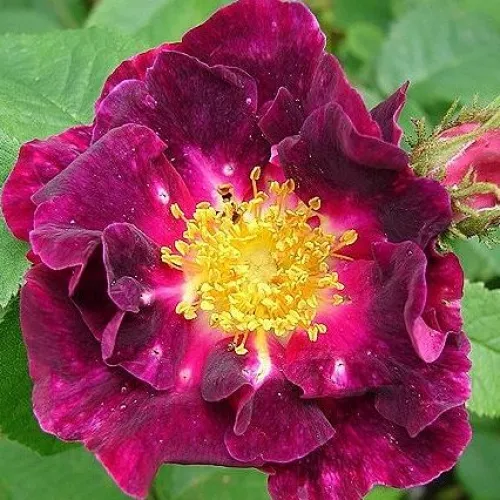
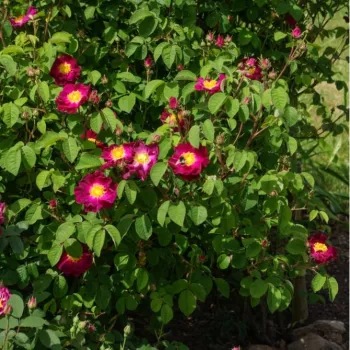
Step onto a narrow front path after rain and you can imagine this historic gallica wrapping your garden in cool, violet-toned fragrance and velvety colour, its dark blooms set against matte green leaves that cope well with damp, breezy UK weather and heavier soils often found in city plots; once planted in your border or a generous 40–50 litre container, the medium-tall, upright habit forms a graceful, sparsely thorned hedge or specimen that keeps its character year after year thanks to its own-root stability, quietly building from establishing roots to stronger shoots and then full ornamental presence over three seasons, for a low-fuss, long-lived investment in your small family garden and front-of-house impact.
Usage options
| Target area |
Reasoning |
| London terraced-house front garden |
Its upright, 120–190 cm growth makes an elegant vertical accent along a short front path without overwhelming narrow spaces, giving a single, spectacular flush of violet-crimson flower and scent in early summer for busy urban gardeners. |
| Rainwater-aware, low-lawn front border |
Planted into improved heavy clay or loamy soil, it copes well with typical UK rainfall, allowing you to replace paving or lawn with a permeable, planted strip that slows runoff and adds summer drama for sustainability-focused homeowners. |
| Feature shrub in a small family garden |
The medium-sized, upright shrub fits neatly into mixed beds, offering children and adults alike a close-up view of its unusual near-black petal edges and old-rose charm without constant pruning for casual family gardeners. |
| Lightly shaded side return or passage |
Its tolerance of partial shade lets you green up side alleys or between-house passages where many roses sulk, bringing colour and scent to a difficult spot with only moderate pruning and feeding for space-conscious city owners. |
| Large container on balcony or paved courtyard |
In a 40–50 litre, peat-free container with good drainage, it forms a long-lived, movable accent; own-root growth helps it recover well if top growth is cut back after winter or wind exposure for container-focused beginners. |
| Low-input heritage rose collection |
This historic gallica, selected for garden use rather than exhibition, suits collections that favour characterful, once-flowering shrubs managed with minimal spraying and straightforward winter pruning for heritage-rose enthusiasts. |
| Seasonal “girly” colour scheme with perennials |
The deep violet-crimson blooms pair beautifully with soft pinks and lilacs, or silver foliage and mauve spikes of lavender and nepeta, creating a romantic, feminine summer moment in compact beds for decor-driven gardeners. |
| Long-term, low-fuss shrub for own-root resilience |
As an own-root rose, it does not rely on a graft union, so it ages steadily, can regenerate from the base after hard pruning or weather damage, and keeps its historic character over many years for long-view garden planners. |
Styling ideas
- Romantic-Frontage – Underplant with soft pink dianthus and airy Coreopsis grandiflora to echo the violet-crimson blooms and create a welcoming, “girly” entrance – ideal for style-conscious terrace owners
- Heritage-Mix – Combine with other historical roses and clipped box or yew for a traditional, story-rich front garden that still feels calm and ordered – suited to period-property caretakers
- Rainwise-Strip – Line a gravelled, soil-filled strip along the pavement with this rose, interplanted with low nepeta and thyme to absorb rainwater and reduce hard surfacing – perfect for sustainability-minded city households
- Soft-Contrast – Pair the dark, velvety flowers with silvery lavender and sage to highlight the colour depth and fragrance while adding drought-tolerant structure – good for time-poor beginners
- Cottage-Edge – Use as a loose, low hedge with Aubrieta spilling at the base for spring colour followed by the rose’s dramatic summer flush – appealing to informal cottage-garden lovers
Technical cultivar profile
| Parameter |
Data |
| Name and registration |
Historical gallica rose marketed as Violacea – deep violet historic Gallica rose; also known in exhibitions as La Belle Sultane, considered an old garden rose of the Gallica, Provins group. |
| Origin and breeding |
Historic variety of unknown parentage, recorded from the Netherlands in 1795; introduced in the United Kingdom by Trevor White Roses and maintained as an unregistered but well-documented heritage cultivar. |
| Growth and structural characteristics |
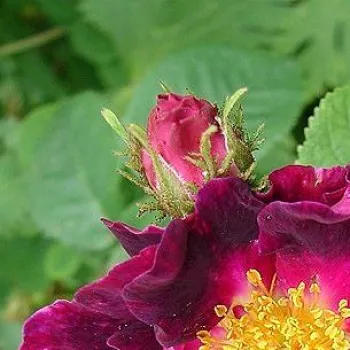
Medium-tall, upright shrub reaching around 120–190 cm in height and 95–150 cm in spread, with moderately dense, matte, mid-green foliage and relatively sparse prickles for easier handling and maintenance. |
| Flower morphology |
Single to lightly filled, medium-sized, cup-shaped blooms, typically 5–12 petals, presented in small corymbs of 2–3 flowers per stem; once-flowering in early season, producing a concentrated display rather than repeat flushes. |
| Colour data and phenology |
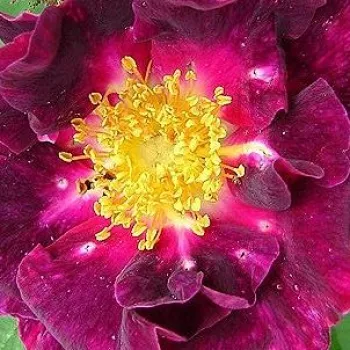
Crimson-purple flowers with a cool violet sheen and pale centre; newly opened blooms show golden stamens, then darken to brownish-purple with near-black edges before fading, offering strong visual drama through the flowering phase. |
| Fragrance and aroma |
Medium-strength, velvety scent with subtly berry-fruity notes typical of old gallicas, noticeable on still, humid days and best appreciated near paths or seating where the once-seasonal bloom period can be fully enjoyed. |
| Hip characteristics |
Occasional, small spherical hips with 10–15 mm diameter, turning orange-red as they mature; they add discrete late-season interest but are produced in modest quantities rather than as a dominant ornamental feature. |
| Resistance and winter hardiness |
Rated to approximately −32 to −29 °C (RHS H7, USDA 4b), with medium resistance to black spot, powdery mildew and rust; benefits from good air circulation, balanced feeding and occasional, targeted pest and disease checks. |
| Horticultural recommendations |
Suited to borders, specimen planting and park uses at 110–180 cm spacing; prefers fertile, well-drained soil, tolerates partial shade, and needs medium maintenance with periodic pruning and, if necessary, supplementary watering. |
VIOLACEA – deep violet historic Gallica rose offers dramatic once-a-year colour, reliable hardiness and long-term own-root resilience, making it a thoughtful choice for characterful, low-fuss gardens.